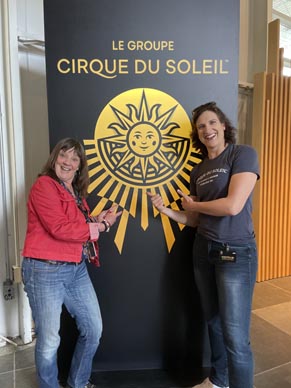
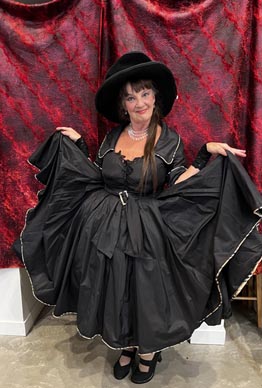
 My first encounter with Doloreze sounds like an impossible story. I was just sitting in the library at the École Nationale de Cirque in Montreal and reading a book called Balancing Acts written by Daniel Lamarre, CEO of Cirque du Soleil. And in the book, he was describing how he started working for Cirque du Soleil and his transformation from a business sector in television into an entertainment business and he mentioned he had a personal clown, Madame Zazou, who had a mission to help him infiltrate into the Cirque mentality, meaning she would walk in during a serious meeting, dressed up in full costume, enlighten the atmosphere and then leave. This was a reminder that even though he was a serious businessman, he was still working for a circus company and he should have this in mind. And then, just next to me, I recognised a cover of a Croatian book placed in front of the shelves, Žene i cirkus and brought it to the main librarian. And there was Madame Zazou, standing! The librarian said ”This is Madame Zazou, who I mentioned to you”;
Doloreze, thank you for sitting down with me and sharing your incredible stories of your more than forty years of artistic experience working in Cirque du Soleil. You have been in Cirque since the beginning and how does it feel today, forty years later? How much has changed since then?
Yes, everything changed because of the mentality, the technology and the people have changed also. For example, people in the backstage area used to talk much more among themselves and now they are talking with their phone. Even when they are warming up for a show. We used to talk much more with each other.
 Does this approach affect the creativity of a performer?
I think it affects you in terms of being constantly under the influence of someone else and where is your own creativity? How can you be proud and say: I really found that, I created that. If you stop constantly searching from outside, on Tik Tok, YouTube, Facebook, you will start to discover what you want, what you feel.
The creativity changed, for example we used to take a year and a half or two to create a Cirque du Soleil show, now it comes down to six months, up to one year to research, develop and create a whole show. Now everything is faster and less refined, and the system is created to be counted in work hours. Previously you were either in the project or out, you did not count hours. We used to do things because of passion, passion to do something, nowadays, it is often because it brings you a piece of bread.
When you work in this circus world, and get out of school, it takes about seven years to realize if you are going to keep doing it or not. It is good if you get a contract immediately after school, but what happens when you don’t have one, for two to three months. What do you do? Will you survive? Are you aware that you will not have a regular monthly income? How can you manage your finances with a job that gets paid in a month or two? Now you need to calculate because you get paid by working days and then there is a gap after finishing a contract.
Do you think now it is harder for younger artists to make a decision to dedicate their lives to this kind of professional work? How do you balance artistic and financial development?
It depends on what kind of ingredients you are made of. Some people like to be pushed and they push themselves, others like to take their time. Sometimes these people don’t fit because the system requires them to create a number within two weeks, and some people don’t work like that, they don’t perform well under big pressure. It is the pressure of society as well. In order not to be pressured, you need to have money. Or you decide to take your time and you decide to have perhaps more simple life but you will have the time to create and dedicate it to yourself. It all depends on what your goal is, to run after money every week, or to have a calmer life, but with less money.
 Do you think the pandemic has left an impact on today’s artists, or the conditions returned like it was before COVID?
During the pandemic, within a year and a half, a lot of artists were suffering, it was very difficult not to work or train, especially for circus disciplines such as flying disciplines (trapeze, silk etc.). Where could you train if not in special rehearsal rooms. It affected many young artists at that time. And since then, there is a fear present all the time, what if another pandemic happens. So, you are pushed to chase work all the time, now, now, now. The competition is strong. Previously the competition was not like that, we were all unique and working and now you can feel the impact of the pandemic. It has left trace on the people to have fear and pressure. Before the pandemic, there were jobs for most of the performers, in theatre, and circus, and vaudeville, the prices were good, there was an audience and after the pandemic people became more cautious about sharing information about auditions.
Are you the only performer in the Cirque du Soleil who has been at the beginning and is still a part of the Cirque company.
Yes, well, me and Guy Laliberté. Others are spread around, or retired.
What keeps you here? Where do you find inspiration to keep going?
It is the passion. I like it. And when you are not married, and do not have kids, you have the time. I could stay at home; I know I would not be bored. There is always something to do, but I still feel that my experience, my happiness and the way I do things are still good for people and for humanity. I am very simple and my kindness and simpleness (it is a new word) they have effect on others. I know I make people feel good.
This week I was driving for two hours to a place where old people were playing bingo and I was performing as Madame Zazou and I call it Bingo Rigolo (Funny Bingo). So as Madame Zazou I would call out the numbers, for example, at number 5 I would say that they needed to do five kisses. So, the players were participating, dancing and having fun while playing bingo. I was having fun with them, making stupid things and they remembered this. What happens there, stays there.

How long have you been doing clowning for elderly and how has that affected you?
I have been doing it for the past year and a half, but when I was young, I got a degree in social work. During my internship, I was going to a place for elderly people and for a year I was bringing them to watch shows, ice skating and concerts. I was already working with the elderly at the age of seventeen and now again, I came back to it. My mother passed away a year ago and my father a few years ago and I miss talking to elderly people. I miss their philosophy. I am now 64 years old; I am not far from them. I miss them talking about how they see life, how much time they dedicate to things. You cannot be rushed with old people, you have to be calm, zen. You practice your zenitude, you cannot be too fast. The way they think, the way they are, and the way they see what is going on around them. I like to have time with them. That is why I think spending time with them at the end of my career is the right thing to do. It does not require being so physically active and now I cannot do things I was able to do 25 years ago.
Do you think society needs more clowns in life? How do you think the role of clowns will develop?
Oh, definitely. It also depends on the finances. For example, in each hospital, where there are children, there should be minimum of two to three clowns working there. And I see the necessity for this, when I work with elderly people, I see how they react, how they smile when they see me. It is just a bonus. But the thing is, how many clowns do we have in the world. It is not a safe job somehow. For acrobats, they have shorter careers, usually they finish at the age of 35 and sometimes it is easier to turn them into clowns. But one of the big problems is, still, the perception of clowns. People expect them to have big puffy hair, colorful clothes, a red nose, and big shoes. I never wore a red nose until I started to work with the elderly. And why? We did not have a clown school here. And even now, when you go to the Ecole Nationale de Cirque in Montreal, not so many students choose the direction of clowning.
 Why do you think this is happening?
I think it is because they come from different disciplines where they need to be serious in order to progress, and for clowning, they need to be funny, and discover how not to be serious. That is also happening within Cirque du Soleil, with the acrobats. They need to learn how to dance, and shake their boogie and have a joyful attitude. We are performing for people, and people buy tickets and come to see you. So, it is better to give happiness than sadness. We have enough sadness in the world already. I think it should be obligatory for all performers, so they can learn how to be funny, and how to make fun of yourself. This is how you learn not to be shy, how to present yourself, you need to know how to be in front of people. You should have some aces ready in your pocket, just in case.
How can young artists build their self-confidence and learn about humor?
This is also one of the missions of the schools to teach students that it is not dangerous to learn clowning or take a clown class. But also, there are not so many clowns in the area of Quebec. We have clown doctors, which brings to the performer’s financial stability, and that is often direction performers choose to go. And this means, at the same time, that there is less chance that these performers will go out on the streets and perform. So, it is a safer way to become a clown.
We don’t have many female clowns now, even in Cirque du Soleil shows. We have more funny characters than clowns. I am trying to bring attention to the fact that we need more female clowns in our shows. Even in creative teams, there is a higher percentage of man than women. Women are more in charge of fabrics, sewing, makeup, costumes.
Why is this happening? Should it be more equal in terms of gender?
If you have a need for a rigger, which is very physically hard work, it is more likely that men will do it. But nowadays, we have more and more women who are doing that job too, with good muscles. And logically, men have bigger hands and are less handy with a needle and thread, but there are so many other jobs where men are leading; music composers, light designers. Nowadays, we have more and more women doing rigging, they are just enjoying wearing big belts, being in the air, having dirty hands, and working hard, and it makes me proud. If we take a look in the wider area, there are not so many female music composers, there is a big imbalance in that area. We are still very stiff, even though there has been progress with gender equality. We used to call all those gender divisions, androgens. That meant, you could be a boy, a girl, choose sex or no sex, but now with all this new terminology, we are still stiff in our mentality. And today, everything is about appearance, how you show yourself to the world and not about passion to be creative.
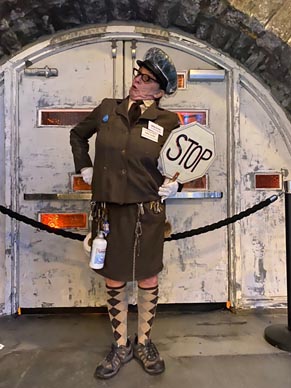
I can compare it to clowns and buffoons. Clowns are cute, and buffoons can say dirty things, they can hurt people saying the truth, and eventually people laugh at that. And they are not cute, nice. We are afraid to be ugly. Most of my characters are ugly, not sexy or nice, with distorted voices, and when you are like that you have to work harder to get people’s attention. And once I get their attention, they stay with me, because they surpass the first impression of cuteness. You can also be very cute, with a tutu, nice make-up, but then you switch and get them.

What is your first memory of clowning?
I was born happy. Since I was a child, everybody was saying ‘Oh, Sunshine is coming’. I have two brothers and a sister, and I am the youngest. I was always making people laugh in the class. And how I ended up in the performing arts, I was replacing someone in Les Échassiers de Baie Saint Paul, (the stiltwalkers of Baie Saint Paul). One of the girls was sick, and they were planning to go on tour, and they told me that I needed to learn how to walk on stilts, how to dance, and sing, to learn all the lines within three days. That was it. After working as a social worker, I jumped into this adventure. I was 20 years old. And after that, they told me they are doing a show on the streets and that I needed to be funny. I did not do any of the things I mentioned, how I create a clown or buffoon. I made a big mistake. I made big lips around my mouth, with a lipstick, and I could not wash it for three weeks. It was summertime and I looked like I had spaghetti around my mouth. And of course, I put black eyeliner around it. So don’t do that! I was so shy. We did not have any school, no clown courses. We learned on the street. The public was my teacher. And later, I took some workshops, about buffoons and drama, with different teachers. And I learned tap dance and flamenco which I could use in my performance.
When did you discover the joy of the buffoon?
I started already in 1984, I studied with Grant Heisler, who was one of the students of Phillipe Gaulier. I was in the buffoon troupe for four years, traveling and performing, not only as a buffoon but as a clown too. And I can easily swap into different roles, which is another quality of buffoon that I like very much.
 How do you start the process of creating a buffoon character?
I start from the outside, from the body. The bad things that I see in a person. Then I decide if it is going to talk in a certain way, what kind of voice he/she has, and then I find the walk. Buffoons often talk very much, and they can hypnotize you with a very long phrase, and by the time you realize what has been said, he or she is already gone. That is what I often call an After Laugh. The audience laughs after they realize what the buffoon has said, but at that moment, the buffoon is gone already, or on some other subject.
How do you create a clown character, compared to buffoon character.
The clown character always comes from inside, depending on how you feel. And then we can play. For example, I can give you five choices on how to make a certain action; let’s try to be vinegar, whip cream, spaghetti, a tree or a small silky fabric. Try these five elements, choices, and see which one you feel the best. I use the same approach for creating buffoons and clowns, I start from the inside by looking at who you are, how you feel.
Thank you very much Doloreze, for this conversation.
Interview by Marijana Matoković, May 9th, 2024
© Marijana Matoković, PLESNA SCENA.hr, June 19th, 2024.
